

Deep Learning with PyTorch: Neural Networks You Can Build
- ✓ Lifetime access
- ✓ All chapters + source
- ✓ Elexa dashboard access
Overview
About This Playbook
What this deep learning playbook covers
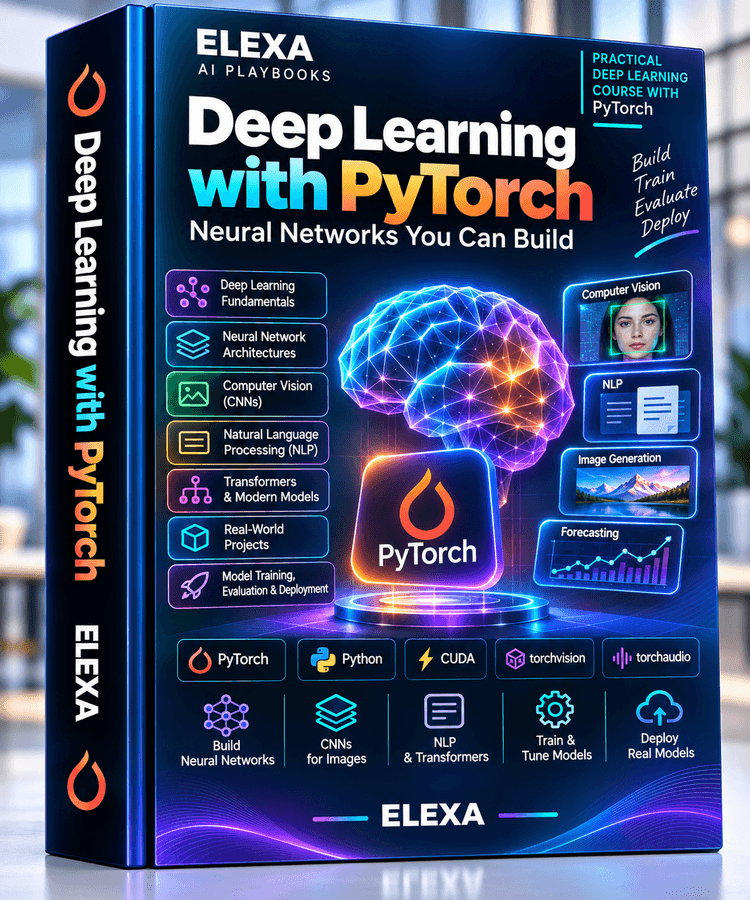
Deep learning is the branch of machine learning behind image recognition, speech assistants and modern language models. It uses neural networks: layers of simple calculations that learn useful patterns from large amounts of data. This playbook explains those networks step by step and shows you how to build, train and improve them with PyTorch.
You start with a single neuron and grow it into full networks. Along the way, you see what weights, loss functions, and gradients actually do, so training stops feeling like magic. Then you apply the same ideas to images and text.
What you will build
Handwritten digit recogniser: your first full neural network, trained from scratch
Image classifier with a CNN: recognising objects in photos, then improving accuracy with transfer learning
Text sentiment classifier: a network that reads reviews and predicts whether they are positive or negative
How the playbook is taught
Every chapter explains the idea in plain language with diagrams, then builds it in PyTorch one small step at a time. You learn to read training curves, spot overfitting and fix it. Each chapter ends with exercises and AI prompts to experiment and debug. The complete source code is included.
Who this playbook is for
It is for developers and students who know basic Python and the main ideas of machine learning, and now want to work with neural networks. If you are new to machine learning, start with the Machine Learning playbook first.
What you need
Python 3, a code editor or Jupyter, and basic machine learning knowledge. A GPU helps but is not required: every project runs on a normal laptop or on free Google Colab.
What You'll Build
What you build and learn in this playbook.
Neural networks made clear
Weights, layers, loss and gradients explained with diagrams before any code.
Images and text
Build networks for both computer vision and language tasks.
Training you can trust
Learn to read training curves and fix overfitting, so your models improve for the right reasons.
Runs without a GPU
Every project works on a normal laptop or free Google Colab.
What you'll learn
- ✓How neurons, layers and activation functions work
- ✓How networks learn with loss functions, gradients and backpropagation
- ✓Build and train models with PyTorch tensors, modules and data loaders
- ✓Use convolutional neural networks (CNNs) for images
- ✓Speed up results with transfer learning and pre-trained models
- ✓Work with text using embeddings and recurrent networks
- ✓Prevent overfitting with dropout, augmentation and early stopping
- ✓Save, load and use a trained model in an application
Prerequisites
- ✓basic Python; the core ideas of machine learning (training, testing, accuracy)
Who it's for
- ✓developers moving into AI, students,
- ✓ML practitioners who want to work with neural networks
Chapters
12 chapters in this playbook
- 1
What is Deep Learning? Set-Up and Your First Tensors
- 2
Neurons, Layers and Activations
- 3
How Networks Learn
- 4
The Training Loop
- 5
Overfitting, Regularisation and Tuning
- 6
Convolutional Neural Networks
- 7
Transfer Learning
- 8
Sequence Models: RNN, LSTM and GRU
- 9
Attention and Transformers
- 10
Autoencoders, Embeddings and Generative Models
- 11
Serving Models and Finishing the Project
- 12
Final Capstone From Satellite Tiles to a Model Service
Who Builds These Playbooks
Elexa AI Team
Architecture-first · Production-style code · AI prompts in every chapter
Every Elexa playbook is written around one rule: explain the why before the code. Each chapter moves from the concept and its tradeoffs to annotated, production-style code, checklists and ready-to-use AI prompts, so you understand the system you're building, not just the snippets.
Frequently Asked Questions
Do I need a GPU?
+
No. All projects run on a normal laptop or on free Google Colab, which gives you a GPU in the browser.
Should I take Machine Learning first?
+
If you are new to machine learning, yes. This playbook assumes you know what training and testing a model means.
Why PyTorch and not TensorFlow?
+
PyTorch is the most widely used framework in research and increasingly in industry, and its code is easier to read while learning. The ideas transfer to TensorFlow.
How much maths is involved?
+
Only what you need to understand training. Each idea is shown with diagrams and small numbers, not long proofs.
Is the source code included?
+
Yes, for every chapter and project.
How long does it take?
+
Most learners finish in 4 to 6 weeks at 1 hour a day

Deep Learning with PyTorch: Neural Networks You Can Build
Ready to start?
One payment. Lifetime access. Real code you can ship.
- ✓ Lifetime access
- ✓ All chapters + source
- ✓ Elexa dashboard access